
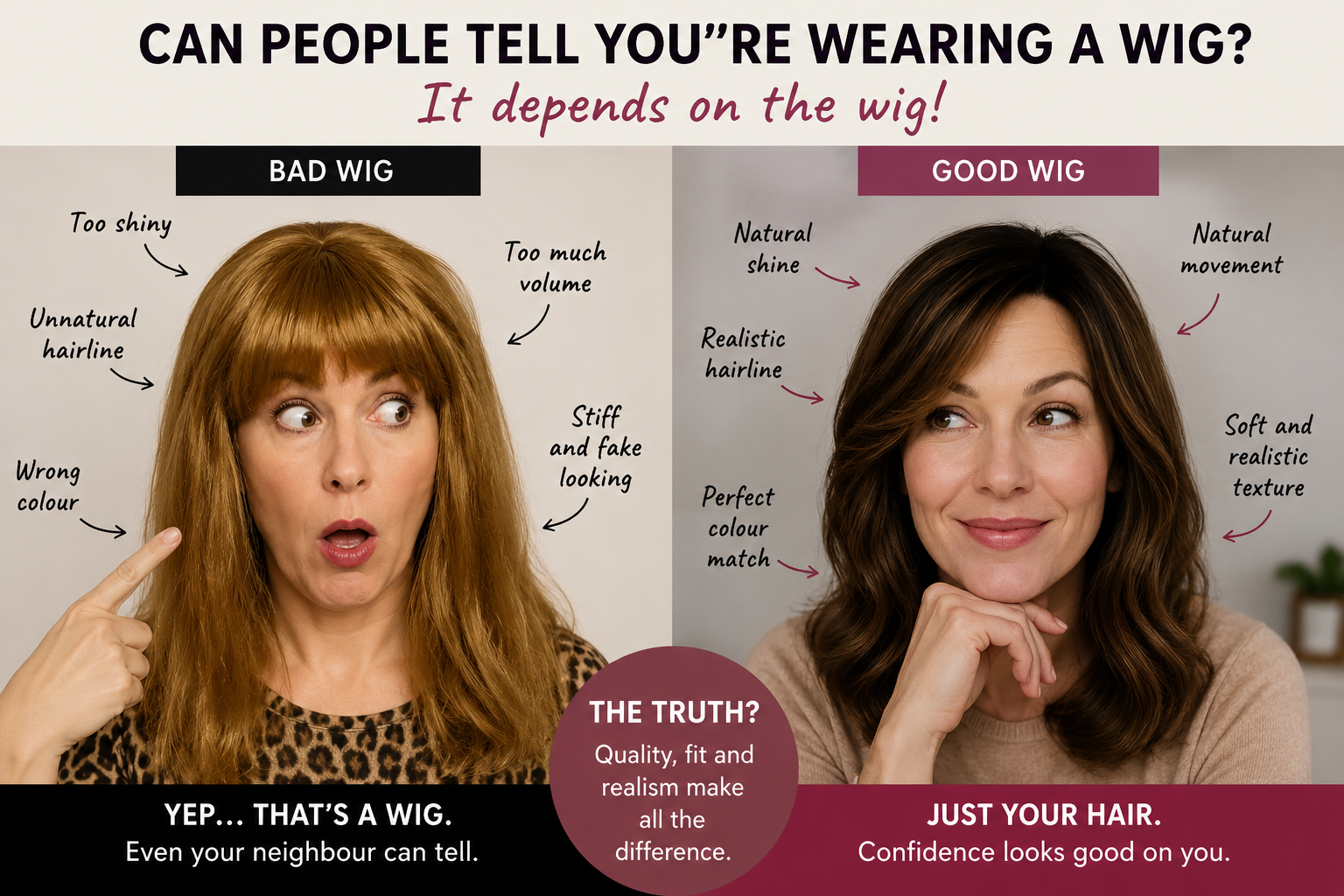
There's a question that comes up in almost every first consultation, whether someone says it directly or not: will people know? It's an understandable concern. For most people, the mental image of a wig is still shaped by cheap synthetic styles from decades ago, obvious, shiny, stiff, and unconvincing. Or the classic bad toupee. That image is so embedded that even people who desperately want a solution sometimes hold back because of it.
The reality in 2026 is genuinely different. The technology has changed, the culture has changed, and the expectations of what a wig looks like have quietly shifted. Part of that is the brands, part is the cap construction innovations, and a significant part is down to celebrities who've been wearing premium wigs openly for years and shown the world what modern alternative hair actually looks like.
"Will people be able to tell?" In everyday social situations, with a properly fitted premium wig, most of the time, no. The more important question is usually: does it suit you, does it fit well, and does wearing it make you feel more like yourself?
Why Modern Wigs Look So Different Today
The public perception of wigs is still largely shaped by the cheap, mass-produced styles that defined the category for decades. Heavily shiny fibres, thick hairlines, stiff movement, and an overall appearance that read as obviously artificial from across the room. Those wigs still exist, and they still look exactly like that.
But premium modern wigs are a different product category entirely. High-quality fibres are now specifically engineered to imitate the movement, texture, softness, density, and colour variation of natural hair. Advanced cap constructions including lace fronts, monofilament tops, and hand-tied sections eliminate the visual tells that used to make wigs identifiable. Rooted colours with dimensional highlights have replaced flat single-tone shades. The hairline, which used to be the most obvious giveaway, can now be genuinely undetectable.
Many wearers are surprised to discover that people they interact with daily, colleagues, friends, even family, don't notice. Not because they're not looking, but because there's genuinely nothing to see.
- Lace front hairlines that are virtually invisible against the skin
- Rooted colours and multi-dimensional highlights for depth and realism
- Heat-friendly premium fibres with reduced shine and natural movement
- Monofilament tops that create a realistic scalp appearance at the parting
- Lighter density options that move and behave like real hair
- Hand-tied sections that flex naturally with head movement
- Breathable, lightweight caps that sit securely without looking padded
How Celebrities Changed The Conversation
The reality is that many people have likely admired a wig in public without ever realising it. One of the most significant shifts in how wigs are perceived didn't come from wig brands. It came from celebrities who started wearing premium wigs openly and talking about it honestly. That normalisation has had a real effect on how everyday people think about alternative hair.
Beyoncé is probably the single most influential figure in changing mainstream attitudes toward wig wearing. Vogue credited Beyoncé as being the turning point in the industry, saying she made it acceptable to wear wigs openly and created a demand for lace-front wigs, which had previously been available mainly in the film and theatre industries. Wig companies saw this as an opportunity to raise their standards and bring premium wigs into the mainstream.
Zendaya has also spoken openly about wearing wigs for red carpet appearances and creative styling, helping younger audiences view wigs as a normal part of modern beauty and fashion culture rather than something secretive.
Kylie Jenner has also openly used wigs to experiment with different colours and styles without permanently altering her natural hair. Her frequent style changes helped introduce younger audiences to the idea that wigs can be part of everyday beauty and fashion rather than something hidden.
For men, Ted Danson has openly admitted to wearing a hairpiece, even famously removing it in an episode of Cheers, a moment that made headlines partly because of how relaxed he was about it.
Beyoncé
Is widely recognised for helping bring premium lace-front wigs into mainstream beauty culture. Credited by Vogue with bringing lace-front technology from film sets into mainstream everyday use.
Zendaya
Wears lace front wigs to protect her natural hair between red carpet appearances, and has been openly matter-of-fact about it with her fanbase.
Kylie Jenner
Changes hair colour and length multiple times per month using wigs without touching her natural hair. One of the most influential voices in modern wig culture.
Gwen Stefani
Has openly discussed using wigs and hairpieces to help maintain her signature looks while protecting her natural hair from constant styling and performance demands.
Ariana Grande
Wears wigs after hair damage from years of styling. Her iconic high ponytail, probably her most recognisable look, is a clip-in piece worn over a braided wig base.
Ted Danson
One of the more openly acknowledged male examples. He has openly admitted to wearing a hairpiece and famously removed it on camera during an episode of Cheers, without any apparent concern.
The broader effect of this celebrity openness is real and measurable. Wig wearing has been quietly destigmatised over the past decade, to the point where it's now a normal part of beauty culture rather than something to hide. That shift benefits everyone, including people who wear wigs for reasons that have nothing to do with fashion.
When Celebrities Build The Brand: Raquel Welch & Eva Gabor
Celebrity influence on wig culture goes deeper than simply wearing them publicly. Two of the most respected names in the premium wig industry are literally named after the women who shaped them, and both have left legacies that continue to define quality standards in the market today.
Raquel Welch, one of Hollywood's most iconic actresses of the 1960s and 70s, launched her wig collection in 1998 in partnership with HairUWear. It became one of the most recognisable and respected brands in the industry. Among her contributions was helping make lace front technology accessible in ready-to-wear wigs for the first time, bringing a construction that had previously been limited to the film industry to everyday consumers. She later became Creative Director of HairUWear, describing her vision as: "fresh, fashion-forward looks, styles that are more fun than fuss." After her passing in 2023, the brand celebrated its 25th anniversary and continues under the creative direction of her longtime personal stylist. The Raquel Welch range uses Tru2Life® heat-friendly synthetic fibre and the Memory Cap® construction, practical, wearable, and consistently well-reviewed.
Eva Gabor, Hungarian-American actress and star of the long-running TV series Green Acres, founded Eva Gabor International in 1969. Within just a few years it became the largest producer of wigs in the world. Two innovations at the time transformed the industry: the capless wig and the Comfort Cap™, which made wigs dramatically lighter, cooler, and less obviously "wiggy" than anything that had come before. Today the brand, now simply known as Gabor, continues as part of the HairUWear family, known for its classic silhouettes, lightweight comfort caps, and soft, natural-looking colour technology. Eva Gabor passed away in 1995 but her name and the brand she built remain genuinely influential in the industry she helped create.
Both brands are available at Wig Beauty:
Raquel Welch Wigs
Established 1998 • Hollywood IconHeat-friendly Tru2Life® fibre, Memory Cap® construction, and lace front styles that helped bring undetectable hairlines to everyday wig wearers for the first time. A brand with 25 years of refinement behind every style.
Browse Raquel Welch at Wig Beauty →Eva Gabor Wigs
Founded 1969 • Industry PioneerThe brand that helped invent the modern comfortable wig. Lightweight caps, natural colour blends, and classic styling make Eva Gabor a reliable, elegant choice for everyday wear.
Browse Eva Gabor at Wig Beauty →Wigs as an Everyday Convenience
One of the bigger changes in recent years is that wigs are no longer used only for medical hair loss or performance. Many people now wear them simply because they're practical. They save time, protect natural hair from daily heat and chemical damage, and allow for a polished appearance without the daily effort of styling.
Premium synthetic wigs with style memory maintain their shape after washing without needing to be blown dry or re-set. For someone who spends significant time each week managing their hair, that's a meaningful shift. A properly maintained synthetic wig can provide a consistently styled, salon-quality look in minutes rather than an hour.
Bad hair day, growing out a bad cut, recovering from colour damage, transitioning between styles, protecting natural hair during a demanding period. These are all genuinely common reasons people reach for a wig that have nothing to do with hair loss. And because modern wigs look so natural, wearing one for practical reasons carries none of the social weight it once did.
Self-Expression, Identity & Personal Choice
Wigs are also worn as a form of personal expression, cultural identity, religious practice, gender expression, and creative freedom. The ability to change your appearance without permanence, whether that's a different colour, length, or texture, appeals to people who enjoy variety and who don't want to commit their natural hair to every experiment.
For women who wear wigs for religious reasons, modern premium options mean that modesty and a natural appearance are no longer in conflict. For people using wigs as part of gender expression, the realism of lace front technology has changed what's achievable. For anyone who simply likes having options, modern wigs provide exactly that.
The online wig community has become large, open, and genuinely supportive. Tutorials, reviews, and honest discussions about fit and maintenance are freely shared, which has made the process of finding the right wig significantly less intimidating than it was even five years ago.
Medical Hair Loss & Emotional Wellbeing
For people wearing wigs because of chemotherapy, alopecia, thinning hair, hormonal changes, or other medical causes, the question of whether people will notice carries particular emotional weight. It's not vanity. It's about feeling like yourself during a time when a great deal may already feel out of your control.
The honest answer is that with a properly fitted, professionally selected premium wig, most people in most everyday situations won't notice. The technology genuinely supports that outcome now in a way it didn't a decade ago. That's not a guarantee, and it's not something that should be the entire focus, but it is a real, practical reassurance worth knowing.
What tends to matter more than the wig itself is how you feel wearing it. Confidence, ease of movement, not constantly checking it or worrying about it. Those things affect how you carry yourself, which affects how people perceive you far more than whether your hair is technically natural.
When A Topper Is All That's Needed
Not everyone experiencing thinning hair needs a full wig. For women with thinning at the crown, a widening part line, or general volume loss, a hair topper can provide highly effective, natural-looking coverage while keeping most of your existing hair intact.
Toppers clip into existing hair and cover only the area that needs it. Because they integrate with your own hair, they often feel and look more natural than a full wig at this stage of hair loss. They're also lighter, quicker to put on, and for many first-time wearers, a more comfortable starting point before deciding whether a full wig is necessary.
- Add targeted volume and coverage without a full wig
- Blend naturally with your existing hair
- Lightweight and breathable for all-day wear
- Ideal for crown thinning and widening part lines
- Available in both synthetic and human hair
- Often the most natural-looking solution at early to moderate stages of hair loss
Browse hair toppers at Wig Beauty →
Why Some Wigs Look More Natural Than Others
Let's be direct about something: with a premium brand wig, properly chosen and fitted, very little gives it away. The things most people associate with "obvious wigs", the plastic shine, the helmet hairline, the stiff movement, are almost entirely the signature of cheap, no-name product. A well-made wig from a respected brand simply doesn't do those things.
When a good wig does look slightly off, it's almost never the wig itself that's the problem. It's usually one or two small mismatches. A density that's slightly too heavy for the face, a colour that doesn't quite sit right against the brows, a cap that doesn't fit snugly at the temples. These are fixable things and they're exactly what a proper fitting catches before you walk out the door.
The things that tend to give cheaper or poorly fitted wigs away:
- Density that's too uniform and heavy. Real hair naturally tapers and moves; a wig that's thick all the way to the hairline reads as manufactured
- Excessive shine. The most immediate giveaway of low-grade synthetic fibre; premium fibres are engineered specifically to avoid this
- A hairline that's too perfect. Real hairlines have fine, irregular baby hairs and natural variation; a ruler-straight edge looks placed, not grown
- Colour that doesn't connect to the brows or skin tone. This is the mismatch the eye goes to first, even if the viewer can't articulate why
- A cap that gaps or lifts at the temples, nape, or behind the ears. Even a beautiful wig looks wrong if the fit isn't right
- Over-caution from the wearer. Constantly touching it, avoiding movement, refusing to let the wind near it. This draws far more attention than the wig ever would on its own
Most people aren't forensically examining your hairline. They're having a conversation with you. Confidence, ease, and a style that genuinely suits your face will always matter more than technical perfection, and with the right wig, the two aren't in conflict.
Modern Hair Systems & Wigs for Men
Everything discussed above applies to men as well, and the options are broader than most people realise. For men who want a hair system that bonds naturally and works across a normal active lifestyle, the Bonding Transbase Human Hair system at Wig Beauty is worth knowing about. It's built on a full monofilament net with a polyurethane perimeter, fully hand-knotted single hair by single hair, and completely breathable. The scalloped front creates a natural receding hairline that styles easily in any direction, a system designed for real daily wear, not just occasional use.
Modern bonded hair systems like this use real human hair matched to your existing colour and density, sitting so naturally against the scalp that in normal social situations, conversation, bright lighting, outdoors, there's genuinely nothing to notice. The gap between these systems and the thick, obvious toupees of decades past is enormous.
For men who prefer not to use a bonded hair system at all, full wigs for men are also a practical option. Wig Beauty stocks a dedicated men's wig range and it's also worth knowing that several styles from Raquel Welch and Envy are genuinely unisex. Both brands produce shorter styles with natural movement and understated colouring that work equally well regardless of gender. If you're not sure where to start, Sigal can help identify styles that suit your face shape and hair loss pattern without it feeling like a compromise.
Most People Notice Confidence Before They Notice Hair
There's a pattern that comes up repeatedly in wig communities and in the experience of long-term wearers: people dramatically overestimate how closely others analyse their hair. In reality, most people are focused on the conversation, on their own concerns, and on the overall impression someone makes. Not on conducting a forensic examination of their hairline.
Confidence, ease, good posture, and comfortable eye contact make far more impression than whether hair is technically natural. A wig worn with ease and comfort typically draws less attention than the anxiety about wearing it. That's not a platitude. It's something most experienced wig wearers discover for themselves and consistently say to first-timers.
The goal isn't to fool anyone. It's to feel like yourself, and with the right wig, that's a realistic, achievable outcome.
Ready To Find Your Perfect Match?
Browse our full range of premium wigs, toppers and hair systems, or book a private consultation at our Edenvale studio.
Can't click Email Us? Write to us directly at: sigal@wigbeauty.co.za