
Hair loss is rarely just a physical thing. For most people it touches something deeper, confidence, routine, how you see yourself in the mirror. That's not something a wig automatically fixes, but the right wig can genuinely help. Not by pretending it isn't there, but by giving you back a sense of control, normality, and comfort during a time when those things can feel hard to hold onto.
The challenge is that buying a wig when you're dealing with hair loss feels very different to choosing one for fashion. There's more at stake, the decisions feel more permanent, and the options can be overwhelming. This guide breaks down what actually matters: cap construction, fibre, fit, and when a topper might serve you better than a full wig, without padding it with things you don't need to know.
Why Getting It Right Matters
Most first-time wig buyers focus almost entirely on hairstyle and colour. Both matter, but experienced wig consultants will tell you that the internal construction of the cap often has a bigger effect on daily satisfaction than either of those things. A beautiful style on a heavy, poorly ventilated cap becomes uncomfortable by mid-afternoon. A realistic colour on a cap that doesn't sit right on a sensitive scalp becomes something you dread putting on.
For someone dealing with medical hair loss, whether from chemotherapy, alopecia, or another cause, comfort and scalp sensitivity often become as important as appearance. Lightweight caps, soft breathable materials, and constructions designed to sit gently rather than grip can make a significant difference to how manageable daily life feels.
The good news is that wig technology has genuinely improved. Lace front hairlines, monofilament tops, hand-tied constructions, heat-friendly fibres. These aren't marketing words, they describe real differences in how a wig looks and feels. Understanding them briefly puts you in a much better position to choose wisely.
Different Types of Hair Loss, Different Needs
Total Hair Loss: Chemotherapy or Alopecia Totalis
When there's little or no natural hair remaining, the scalp is often more sensitive and the wig carries more visual responsibility. Cap comfort becomes critical. There's nothing to buffer the cap against the skin, so the softness and breathability of the materials matter more. At the same time, realism at the hairline and crown becomes important because there's no natural hair to blend with.
The most effective constructions for total hair loss combine a lace front (for a realistic, undetectable hairline) with a monofilament top (for a natural scalp appearance at the parting) and open or breathable sections at the sides and back to reduce heat and improve airflow. Fully hand-tied caps are the most comfortable option for very sensitive scalps.
- Amanda by Envy A medium-length lace front and mono top wig offering a natural hairline and breathable comfort for sensitive scalps. View on Wig Beauty →
- Angie by Envy A softly layered lace front design built for realistic movement and comfortable full coverage. View on Wig Beauty →
- Idalia by Jon Renau A popular lace front style with natural density and a refined finish well suited to complete hair loss. View on Wig Beauty →
Thinning Hair or Partial Hair Loss
If you still have meaningful natural hair, a full wig isn't always the right starting point. For thinning at the crown, widening part lines, or gradual volume loss, a hair topper often provides better coverage with less compromise. It integrates with your existing hair rather than replacing it entirely, which tends to feel more natural and more comfortable day to day.
Toppers clip into your hair and are designed to cover specific areas. They feel lighter than a full wig, are quicker to put on, and for many women at this stage of hair loss, they're simply the more practical solution. See the dedicated topper section below for more detail.
Alopecia Areata
Alopecia areata creates patchy, unpredictable hair loss that can change over time. The most useful wigs for this type of hair loss are adjustable, with a good fit that can be refined as your situation changes, and lightweight enough for daily wear without becoming uncomfortable on sensitive patches of scalp. Lace front and monofilament constructions work well here because they look natural even when styling hair away from the face, which can be important when patches appear near the hairline.
- Alyssa by Envy Lightweight and layered with natural movement. A comfortable everyday choice for patchy hair loss. View on Wig Beauty →
- Amber by Envy Soft texture, realistic lace front hairline, and a gentle fit well suited to sensitive scalps. View on Wig Beauty →
Cap Construction: The Bit Most People Skip
Two wigs in the same style and colour can look and feel completely different depending on how the cap is built. Here's a plain-language guide to the main construction types and what each one actually does.
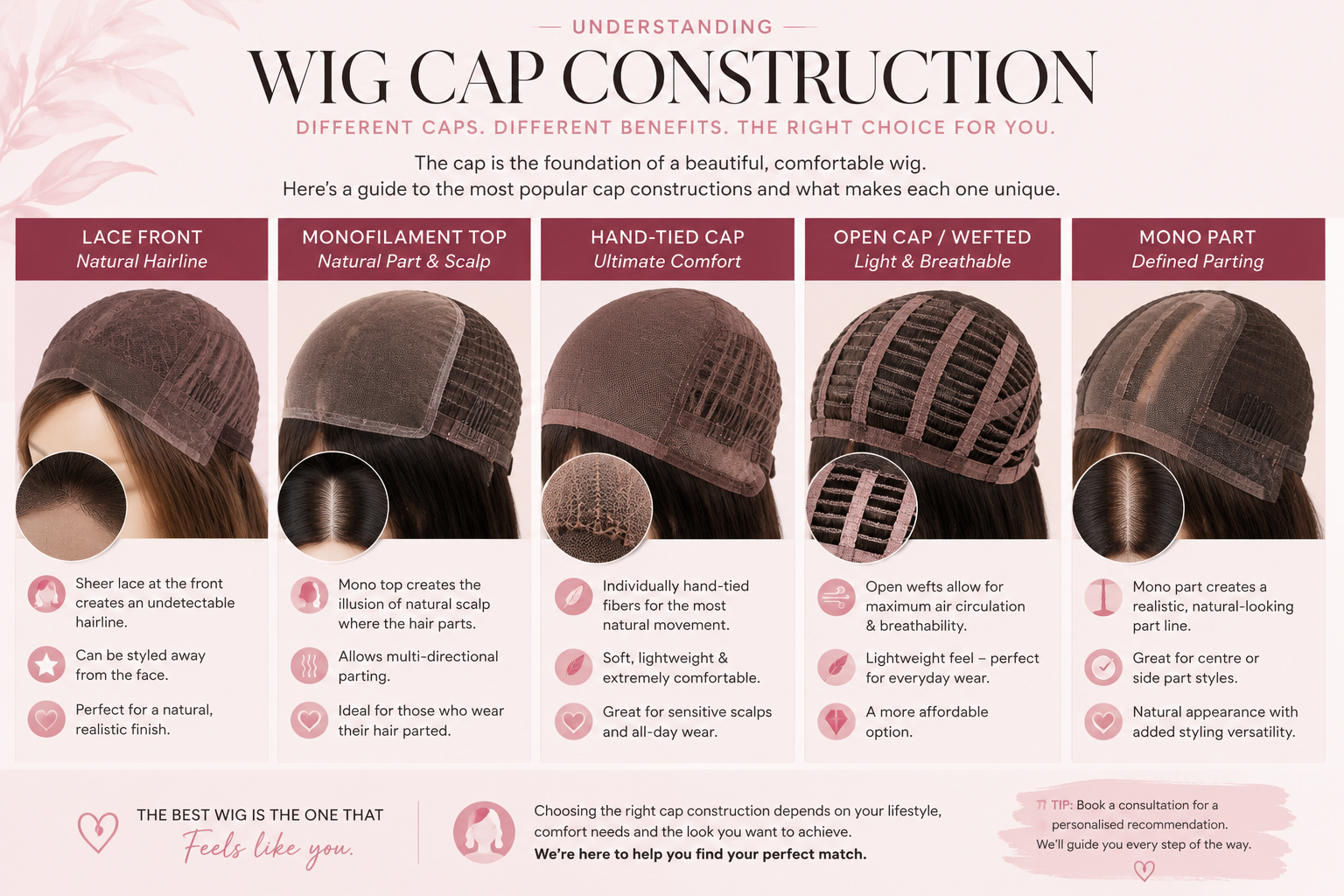
Lace Front
A sheer lace panel along the front hairline where each hair is individually hand-tied. Against the skin, the lace becomes nearly invisible, giving the appearance of hair growing naturally from the scalp. This is what allows you to wear the hair off the face or swept back without an obvious wig line. The lace front describes the hairline only, and the rest of the cap can be any construction.
Monofilament Top
A transparent mesh section across the top of the cap where each hair is individually knotted. This creates the illusion of a natural scalp at the parting and allows the part to be moved in different directions. From above, which is how people often see you, a monofilament top looks convincingly real. It also feels smoother against the scalp than standard wefted construction.
Hand-Tied
Every hair in the cap is individually knotted by hand, not just the top or the front, but the sides and back as well. The result is the softest, most flexible cap available. The hair moves naturally in all directions, and the cap conforms to the shape of the head rather than sitting rigidly on it. For anyone with a sensitive or bare scalp, hand-tied is meaningfully more comfortable than other constructions. It's also the most labour-intensive to produce, which is reflected in the price.
Open Cap (Capless / Wefted)
Machine-sewn rows of hair with open spaces between them for airflow. Lighter, cooler, and more affordable than monofilament or hand-tied options. The parting isn't as realistic and you can't change where it falls, but the comfort and breathability are genuine advantages, particularly in South Africa's warmer climate. Many wigs combine an open wefted back with a lace front or mono top for the best of both.
Mono Part
A hand-tied monofilament section at the part line only, with the rest of the cap wefted. A practical middle ground, more realistic at the part than a standard open cap, less expensive than a full monofilament top. Good value for everyday wear.
For medical hair loss and sensitive scalps, the recommendation is consistently towards softer, more breathable constructions, hand-tied or double monofilament where the budget allows. The difference between a wefted cap and a hand-tied one against a bare or tender scalp is something most wearers notice immediately.
Synthetic vs Human Hair: What Makes Practical Sense
Synthetic Wigs
Synthetic wigs are pre-styled and hold their shape after washing. You don't need to blow-dry or restyle them, which is a genuine advantage when you're already managing a lot. Modern premium synthetic fibres have improved significantly over the past decade and can look very natural in everyday lighting and social situations.
They're generally more affordable, require less day-to-day effort, and perform well in humidity, which matters in South Africa. The main limitation is that standard synthetic wigs can't be heat styled, though many brands now offer heat-friendly synthetic fibres that allow limited styling with low heat.
For most first-time wig wearers dealing with medical hair loss, synthetic is often the more sensible starting point. The lower maintenance requirement reduces daily effort during an already demanding time.
Human Hair Wigs
Human hair wigs offer the most natural look, feel, and movement. They can be cut, coloured, and styled like your own hair. The trade-off is that they require the same care routine as natural hair, regular washing, conditioning, and styling, and they're considerably more expensive.
For long-term everyday wear and those who are comfortable with the maintenance, human hair is worth the investment. For someone going through chemotherapy who already has a great deal to manage, a high-quality synthetic is often the more practical choice.
Human Hair Blends (e.g. EnvyHair™)
Blended fibres like Envy's EnvyHair™, a 70% heat-friendly synthetic and 30% human hair blend, sit usefully in between. The human hair component adds softness and natural movement. The synthetic component holds the style and resists weather. Heat styling is possible up to moderate temperatures. For everyday wearers who want more realism than standard synthetic without the full maintenance demands of human hair, blends are a strong option.
Hair Toppers: Worth Knowing About
A topper is a partial hairpiece designed to cover specific areas of thinning or loss, usually the crown, the part line, or the top of the head, while blending into your existing hair. It clips in rather than covering the full scalp, which makes it feel lighter and more natural for many women who still have reasonable coverage elsewhere.
Toppers work particularly well for women experiencing early to moderate thinning, widening parts, postpartum hair loss, crown thinning from age-related changes, or early-stage alopecia. Because they integrate with your own hair rather than replacing it, the overall result is often more natural than a full wig at this stage of hair loss.
They're also easier to wear during a transition period. Many women start with a topper and graduate to a full wig only if and when their hair loss progresses. Modern toppers include the same cap technologies as full wigs:
- Monofilament bases for a realistic scalp appearance at the coverage area
- Lace fronts for natural-looking hairlines on larger toppers
- Heat-friendly and human hair fibres for styling flexibility
- Various base sizes depending on how much coverage is needed
- EasiCrown 12" Human Hair Topper by Jon Renau Lightweight human hair topper for natural volume at the crown and part line. View on Wig Beauty →
- EasiCrown 18" Human Hair Topper by Jon Renau Extended coverage for more advanced thinning, blending naturally with longer hair. View on Wig Beauty →
Practical Tips Before You Buy
- Measure your head properly. A wig that doesn't fit correctly will never feel fully comfortable or secure. Most premium wigs include adjustable straps, but starting with the right approximate size makes a difference.
- Look at colours in natural light. Indoor lighting changes how shades read. Rooted colours and highlighted blends generally look the most natural in daylight, while flat single-tone colours can look less convincing up close.
- Think about your climate and how long you'll be wearing it. South Africa's warmth makes breathability a real consideration. Open cap and lace front constructions ventilate far better than heavier designs for all-day wear.
- Match the maintenance to your capacity. During chemotherapy or high-stress periods, a low-maintenance synthetic is often more realistic than a human hair wig that needs daily styling attention.
- Consider density carefully. Many first-time wearers feel more natural in a lighter-density style similar to their previous hair rather than a dramatically different look. Give yourself time to adjust.
- If you can, try before you buy. Seeing colour, fit, movement, and cap comfort in person removes most of the guesswork. Wig Beauty offers private consultations at our Edenvale studio specifically for this.
- Many experienced wearers end up with two wigs. One comfortable everyday style and a second for different occasions or weather. It's not an extravagance. It extends the life of both and gives you genuine flexibility.
Final Thoughts
Modern wigs for hair loss are genuinely better than they were even five years ago, more breathable, more realistic, more comfortable, and available across a much wider range of budgets than most people expect. The technology has caught up with the need.
The most important thing isn't finding the perfect wig on the first try. It's understanding enough about cap construction, fibre type, and your own lifestyle to make a choice that works for you practically, something you'll actually wear with confidence rather than something that sits in a drawer because it's uncomfortable by mid-morning.
If you're not sure where to start, a private consultation with Sigal at the Wig Beauty Edenvale studio is the most direct route. You'll be able to try different styles, cap constructions, and colours in person, and get honest guidance based on your specific situation rather than a generic recommendation.
Need Help Choosing the Right Wig?
Book a free private consultation at our Edenvale studio, browse online, or get in touch. We're happy to help you find the right solution.
Can't click Email Us? Write to us directly at: sigal@wigbeauty.co.za